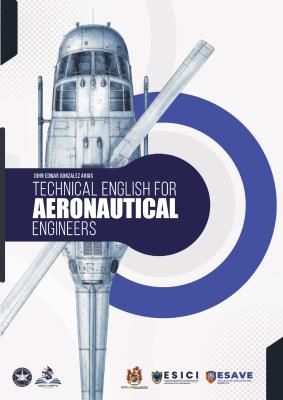
Technical English for Aeronautical Engineers
Keywords:
Airworthiness, Avionics Systems, Maintenance Directive, Powerplant, Flight Control Systems, Flight Control SurfacesSynopsis
This book serves as an essential pedagogical tool designed to bridge the linguistic gap in the aerospace industry. Its primary objective is to empower aeronautical engineers, technicians, and military aviation personnel to master technical English, the universal language of aviation. Through a comprehensive approach, the text rigorously supports the development of applied grammar, reading comprehension for manuals, technical report writing, precise terminology pronunciation, and specialized professional vocabulary.
The greatest benefit of this book lies in its ability to transform theoretical language knowledge into practical, real-world operational skills. For engineers, it acts as an indispensable support system for accurately interpreting airworthiness directives, service bulletins, and complex blueprints, thereby drastically reducing human error in aircraft design and maintenance. For military personnel, it becomes a strategic guide that optimizes interoperability during international missions and standardizes safety communications under global regulations, such as ICAO standards.
Beyond basic grammar, the book features practical exercises based on authentic hangar and cockpit scenarios, facilitating the retention of critical concepts in aerodynamics, avionics, and propulsion systems. By enhancing pronunciation and oral communication, personnel gain the necessary confidence to interact effectively in high-pressure environments. In conclusion, this manual is not merely an educational resource; it is a cornerstone of operational safety and efficiency that elevates the professional standards of both civil and military aviation worldwide.
Downloads
References
Anderson, J. D. (2016). Introduction to flight (8ª ed.). McGraw-Hill Education.
Baker, A., Dutton, S. & Kelly, D. (2004). Composite materials for aircraft structures (2ª ed.). American Institute of Aeronautics and Astronautics. https://doi.org/10.2514/4.861680
Campbell, F. C. (2006). Manufacturing technology for aerospace structural materials. Elsevier Science. https://doi.org/10.1016/B978-1-85617-495-4.X5000-8
De Florio, F. (2016). Airworthiness: An introduction to aircraft certification and operations (3ª ed.). Butterworth-Heinemann. https://doi.org/10.1016/B978-0-08-100888-1.00005-7 PMid:27815135
Delgado, J. (2018). Mantenimiento de aeronaves y gestión de hangares. Ediciones Paraninfo.
Ellis, S. & Gerighty, T. (2015). English for Aviation: for pilots and air traffic controllers Express Series. Oxford University Press.
Emery, H. & Roberts, A. (2008). Aviation English: For pilots and air traffic controllers. Macmillan.
European Union Aviation Safety Agency. (26 de noviembre de 2014). Commission Regulation (EU) No 1321/2014 on the continuing airworthiness of aircraft and aeronautical products, parts and appliances, and on the approval of organisations and personnel involved in these tasks Text with EEA relevance. [Document 32014R1321]. easa.europa.eu. http://data.europa.eu/eli/reg/2014/1321/oj
Federal Aviation Administration. & U.S. Department of Transportation. (2012). Operator's manual for human factors in aviation maintenance. U.S. Department of Transportation.
Federal Aviation Administration. & U.S. Department of Transportation. (2018). Aviation maintenance technician handbook—Airframe (FAA-H-8083-31A) (Volume 1). Aviation Supplies & Academics, Inc.
Federal Aviation Administration. & U.S. Department of Transportation. (2023). Aviation maintenance technician handbook—General (FAA-H-8083-30B). Aviation Supplies & Academics, Inc.
Gramopadhye, A. K. & Drury, C. G. (2000). Human factors in aviation maintenance: how we got to where we are. International Journal of Industrial Ergonomics, 26(2), 125-131. https://doi.org/10.1016/S0169-8141(99)00062-1
Kinnison, H. A. & Siddiqui, T. (2012). Aviation maintenance management (2ª ed.). McGraw-Hill Education.
Magnific. (2026). Diseño de plantilla de folleto. [imagen vector portada]. Magnific.com. https://www.magnific.com/ es/vector-gratis/diseno-plantilla-folleto-perfil-empresa-corporativa_29011247.htm
Megson, T. H. G. (2016). Aircraft structures for engineering students (6ª ed.). Butterworth-Heinemann.
Mouritz, A. P. (2012). Introduction to aerospace materials. Woodhead Publishing. https://doi.org/10.2514/4.869198 https://doi.org/10.1533/9780857095152
Niu, M. C. Y. (2001). Airframe structural design: Practical design information and data on aircraft structures (2ª ed.). Conmilit Press.
Raymer, D. P. (2018). Aircraft design: A conceptual approach (6ª ed.). American Institute of Aeronautics and Astronautics. https://doi.org/10.2514/4.104909
Sales, M. (2016). Aviation logistics: the dynamic partnership of air freight and supply chain. Kogan Page.
Shawcross, P. (2011). Flightpath: Aviation English for pilots and ATCOs. Student’s book. Cambridge University Press.
Soutis, C. (2005). Fibre reinforced composites in aircraft construction. Progress in Aerospace Sciences, 41(2), 143-151. https://doi.org/10.1016/j.paerosci.2005.02.007 https://doi.org/10.1016/j.paerosci.2005.02.004
Downloads
Published
Series
Categories
License

This work is licensed under a Creative Commons Attribution-NonCommercial-NoDerivatives 4.0 International License.